

Probiotics: Drinks, Foods or Supplements: Which Is Best?
Did you know that many probiotic supplements on the market don’t actually contain all the beneficial microflora they claim to contain? Find out how to be SURE you get the probiotics you need to build your immunity.
If you look at the shelves of your local health food store, you may be confused by the vast array of probiotic supplements.
Probiotics are the buzz word in health these days for a good reason. With benefits ranging from boosting your immunity to easing Irritable Bowel Syndrome, treating autism and ending cravings, it’s no wonder we want our probiotics.
But how can you be sure that these probiotics contain all the friendly microflora necessary to populate your gut, build your immunity, and help you digest and assimilate your food?
The Business of Probiotics
According to the latest research, probiotics are big business, and sales of probiotics are expected to exceed 64 billion USD by 2023.
In a lucrative market, it’s no surprise that supplement manufacturers would want a piece of the probiotic pie. Often, in the race to create a product with so many millions of beneficial bacteria strains and with little FDA regulation, one thing is becoming clear: not every supplement manufacturer understands the true nature of healing your inner ecosystem.
So while we know probiotics absolutely have nutritional value, what you see on the label may NOT be what you get.
In fact, two researchers at Bastyr University in Washington tested a wide variety of probiotic supplements and found that in four out of twenty products no sign of living friendly bacteria was present1.
The unfortunate truth is that too many probiotic supplements vary widely in quality and potency. Here’s why:
- Many probiotic supplements cannot survive harsh stomach acid in order to get to your intestines.
- Manufacturers talk about number of CFUs (colony forming units), but don’t always offer the types or combinations of probiotics that are ideally suited to human intestines. So while they have some value, they do not help re-colonize your inner ecosystem, which is the overall goal.
Just like the Earth has ecosystems that strive for balance, your body has it’s own “inner ecosystem.” At the heart of your inner ecosystem are probiotics, the beneficial microflora that keep you healthy and strong. Products containing these beneficial microflora are called probiotics.
After decades of studying exactly which microflora allow your inner ecosystem to thrive, Donna Gates developed the Body Ecology system with probiotic-rich fermented foods and drinks as one of the mainstays of health and healing.
Best Probiotics?
Fermented foods and drinks can be your best solution to ineffective probiotic supplements!
Here are some reasons that fermented foods and drinks are superior:
- Beneficial bacteria and yeast in fermented foods and drinks are live and active! Whether you purchase fermented foods and drinks or make them at home, you are getting active bacteria.
- Fermentation pre-digests vital nutrients for you. Packed with B vitamins, minerals and enzymes, fermented foods and drinks are whole foods full of nutritional value in their own right. On top of that, the microflora increase the bioavailability of the nutrients in all the foods you eat by hundreds of times.
- Fermentation does not use heat. Your fermented foods and drinks retain their vital amino acids that can be destroyed by heat.
- You get a variety of live cultures supplied by nature in fermented foods and drinks. Lab produced probiotics are often a single strain of bacteria, like Lactobacillus acidophilus.
- Supplements contain bacteria only while fermented foods and drinks also contain “food” for the microflora to help promote their growth. It’s like sending the good guys down into your digestive tract with a lunchbox of goodies to sustain them on their long and perilous journey down under. Once they reach their destination (and IF they reach their destination) the microflora in a supplement need up to 6 hours to colonize in your intestines. The microflora in fermented foods and liquids are so hardy they start working at once.
- Fermented foods and drinks are acid-resistant and are viable in your system from the time they touch your lips all the way down into your gut.
Body Ecology is on the cutting edge of using probiotics to impact your health, and because we believe in the healing value of beneficial bacteria and yeast, we have created several different ways for you to get daily doses of high quality, potent microflora in your diet.
(If you are just starting to use probiotics, be sure to read Is It Possible To Get Too MUCH Fermented Food In Your Diet? by Dr. Leonard Smith.)
Our probiotic liquids and culture starters fit every lifestyle and every taste to populate your gut with a variety of nature’s beneficial bacteria and yeast.
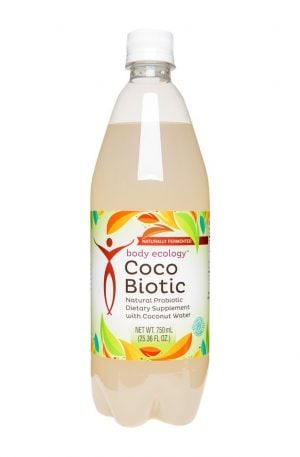 Cocobiotic is a potent probiotic drink that gives your body beneficial bacteria it needs on the go!
These probiotic drinks not only supply your body with four active cultures but these essential bacteria or masters of homeostasis help to defend your body against disease-causing bacteria, viruses, yeast, pathogens, and other dangerous invaders.
Our fermented drinks contain live probiotics, uniquely designed to re-colonize your intestines.
Make Your Own!
You can also make your own fermented foods and drinks at home with Body Ecology fermented food and drink starters.
Our starters are carefully formulated so that you can reap the health benefits of probiotics at home by making cultured vegetables, cultured butter, Young Coconut Kefir and milk kefir.
Try these fermented food starters and have fun doing it yourself:
- Kefir Starter is perfect for homemade milk kefir and Young Coconut Kefir.
- Culture Starter makes delicious vegetables and whipped cultured butter or crème fraiche (aka sour cream). Try it today!
To learn more about each starter, read Which Fermented Food Starter Should You Use For What?
Probiotics The Easy Way
Until a supplement exists that delivers the beneficial bacteria and yeast you need for a healthy inner ecosystem, you can rely on our probiotic liquids, and fermented foods and drinks that you can make yourself.
You’ll be sure that you’re getting potent probiotics every time!
Sources:
- Condor, Bob, “Living Well: ‘Friendly’ probiotics have some cons, too,” Seattle P-I, 18 Dec, 2006.
LATEST ARTICLES




POPULAR ARTICLES



Customer Reviews

Really settles my stomach. Love it!
This is an excellent probiotic, I drink it daily.


